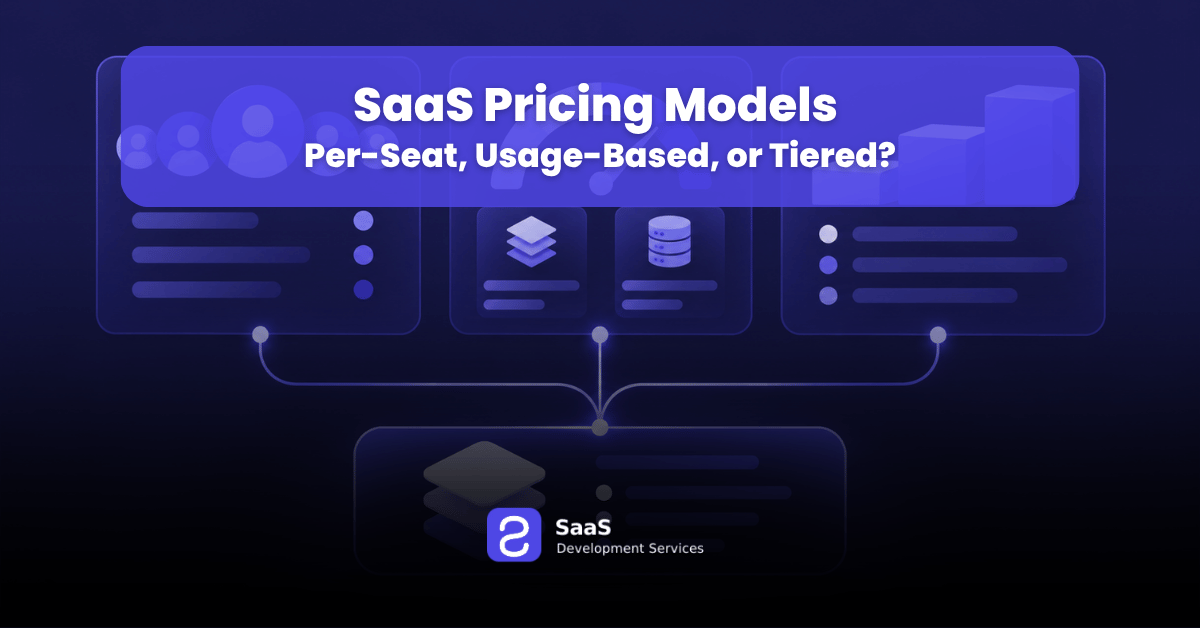
SaaS pricing models decide how your revenue grows after the first sale. Three models cover most products. Per-seat pricing charges for each user. Usage-based pricing charges for what customers consume. Tiered pricing charges for a bundle of features and limits. The right choice depends on how your customer measures value.
Many founders copy a rival’s pricing page and then ask a saas development company to build it. That order causes trouble, because each model needs different features inside the product. This guide compares the three models, shows where each one breaks, and explains what your product must support.
What Are the Main SaaS Pricing Models?
The main SaaS pricing models are per-seat, usage-based, and tiered. Per-seat counts users. Usage-based counts consumption, such as API calls or data processed. Tiered sells plans with set features and limits. Tiered is a packaging choice, so it usually sits on top of the other two.
| Model | You bill on | Revenue grows when | Best for | Breaks down when |
|---|---|---|---|---|
| Per-seat | Users or logins | The customer adds team members | CRM, support, project tools | AI or automation cuts logins |
| Usage-based | API calls, data, tokens | Consumption rises | Infrastructure, data, AI products | Bills spike or usage dips |
| Tiered | Feature bundles and limits | The customer upgrades a plan | Buyers of mixed sizes | Limits feel random |
How Does Per-Seat Pricing Work in SaaS?
Per-seat pricing charges a fixed fee for each user every month. Revenue equals users times seat price. It is easy to explain, forecast, and budget, which is why Salesforce and Microsoft 365 use it. Slack bills only for active users, which makes seats feel fair.
- Best used when: value grows with headcount, as in CRM, support, and project tools.
- Revenue grows when: your customer hires more people.
- Breaks down when: AI or automation does the work. Fewer logins mean less revenue, even if your product performs better.
- Watch for: shared logins and customers who cap seats to control cost.
If you buy saas product development services for a seat-based product, ask for roles, admin controls, and seat tracking in the first release.
How Does Usage-Based Pricing Work in SaaS?
Usage-based pricing charges customers for what they consume, such as API calls, messages, data processed, or AI tokens. Revenue equals consumption times unit price. Twilio is a well-known example. Customers start small and pay more only as they grow.
- Best used when: value scales with volume, as in infrastructure, data pipelines, and AI products.
- Revenue grows when: customer consumption and workflow volume rise.
- Breaks down when: spikes cause bill shock, or slow months cut revenue and weaken forecasts.
- Watch for: customers who ration usage to save money and never see the full value.
Interest in this model is rising. A January 2026 ICONIQ survey of about 300 software executives building AI products found that 35% now use consumption-based pricing, up from 19%. Metering is an engineering job, so your saas application development services should include event tracking, usage dashboards, and spend alerts.
How Does Tiered Pricing Work in SaaS?
Tiered pricing sells pre-packaged plans with set features and limits. Customers upgrade when they outgrow a plan. It suits products that serve different buyer sizes, such as small teams and large enterprises.
Here is a point many guides miss. Tiered pricing is not a billing metric. A tier can charge per seat, per usage unit, or a flat fee. Mailchimp, for example, sets its tiers by contact count.
- Best used when: small and large buyers need different capability levels.
- Revenue grows when: a customer upgrades to a higher plan.
- Breaks down when: limits feel random, so users find workarounds instead of paying.
- Watch for: too many plans. Three or four are easier to understand than six.
Tiers need feature flags, plan limits, and clear upgrade prompts. With custom saas development, you can build plan rules that fit your product instead of forcing it into a billing tool’s template.
Why Are Most SaaS Companies Moving to Hybrid Pricing Models?
A hybrid pricing model combines a base platform fee with a usage layer. AI is pushing this shift. When software does work without a human login, seat counts stop matching the value delivered.
Bain studied more than 30 SaaS vendors that added generative AI. About 35% raised seat prices and bundled AI into existing plans, as Zoom did. About 65% added an AI meter on top of seats, as Adobe and Salesforce did. None had moved fully to usage or outcome pricing.
A September 2026 Bain report on about 200 B2B SaaS companies adds a new detail. Around 80% of vendors introducing AI pricing chose capacity models, where customers commit to a fixed amount of usage for a set period. Customers get a steady budget and vendors get steady revenue.
Older seat-based products often need changes to support this. saas modernization services can add metering and plan logic to an existing product.
How Do You Choose the Right SaaS Pricing Model?
Choose the model that matches your customer’s value metric. Ask what grows when your customer succeeds: people, volume, or capability. Then match the answer to a model and test it with real buyers.
- People grow: use per-seat pricing.
- Volume grows: use usage-based pricing or capacity commitments.
- Buyers differ in size: use tiered plans.
- Software does the work: use a hybrid base fee plus a meter.
Run four checks before you decide:
- What does the customer count as value? Users, tasks, records, or results.
- Do your costs rise with use? AI features add inference costs, so a flat seat price can lose money on heavy users.
- Who signs the contract? Enterprise buyers often want a predictable budget. Plan for it with enterprise saas development services that cover invoicing, usage reports, and admin controls.
- Can your product measure it? Vendors cannot price on usage if they do not know what customers use.
How Do You Switch SaaS Pricing Models Without Losing Customers?
Switch in small steps. Keep the old plan for current customers, test the new plan with new signups, and run the new meter beside the old one before you remove anything.
- Track usage for a few billing cycles before you charge for it.
- Show a preview of the new bill on invoices.
- Keep current customers on their old plan for a set period.
- Add spend caps and alerts to prevent bill shock.
Cost timing matters too. Bain gives one example: a $40,000 AI agent that could replace an $80,000 sales rep. During testing the customer pays for both, so their cost rises by 50%. Delayed payments or flexible contracts help close that gap.
If your codebase is tangled, metering is hard to add. In that case, saas platform modernization services may need to come before the pricing change.
Frequently Asked Questions About SaaS Pricing Models
What is the most common SaaS pricing model?
Per-seat pricing is still the most common base model in B2B SaaS, and tiered plans are the most common way to package it. Hybrid models are growing quickly, especially in products with AI features.
Is tiered pricing a real pricing model?
Tiered pricing is better seen as packaging. It groups features and limits into plans, and each plan can still bill per seat, per usage unit, or a flat fee.
When should I choose usage-based pricing over per-seat pricing?
Choose usage-based pricing when value follows volume, as in APIs, data tools, and AI products. Bain says direct usage pricing keeps a role in infrastructure software and in products sold to technical buyers.
What is capacity-based pricing?
Capacity-based pricing lets customers commit to a fixed amount of usage for a set period. Unused capacity is generally not refunded or carried forward. Customers get a steady budget, and vendors get steady revenue.
Does my pricing model change how I build my SaaS product?
Yes. Per-seat needs user management, usage-based needs metering, and tiered needs plan limits. Work with a saas app development company that asks about your pricing model before it designs the data model and billing setup.
Can a development partner help me set up billing and metering?
Yes. Good saas development services cover usage tracking, plan limits, billing integration, and customer dashboards, so a pricing change does not force a rebuild.
Conclusion
Per-seat pricing fits products where value grows with headcount, usage-based pricing fits products where value grows with volume, and tiered pricing is a packaging layer that sits on top of either one. Most B2B SaaS companies now mix a base fee with a usage meter, because AI breaks the link between seats and value. Pick the model that matches how your customer measures success, then build the metering, plan limits, and billing that model needs.
Ready to build a product around the right pricing model? Work with a saas software development company that plans billing and metering from day one. Contact us here.