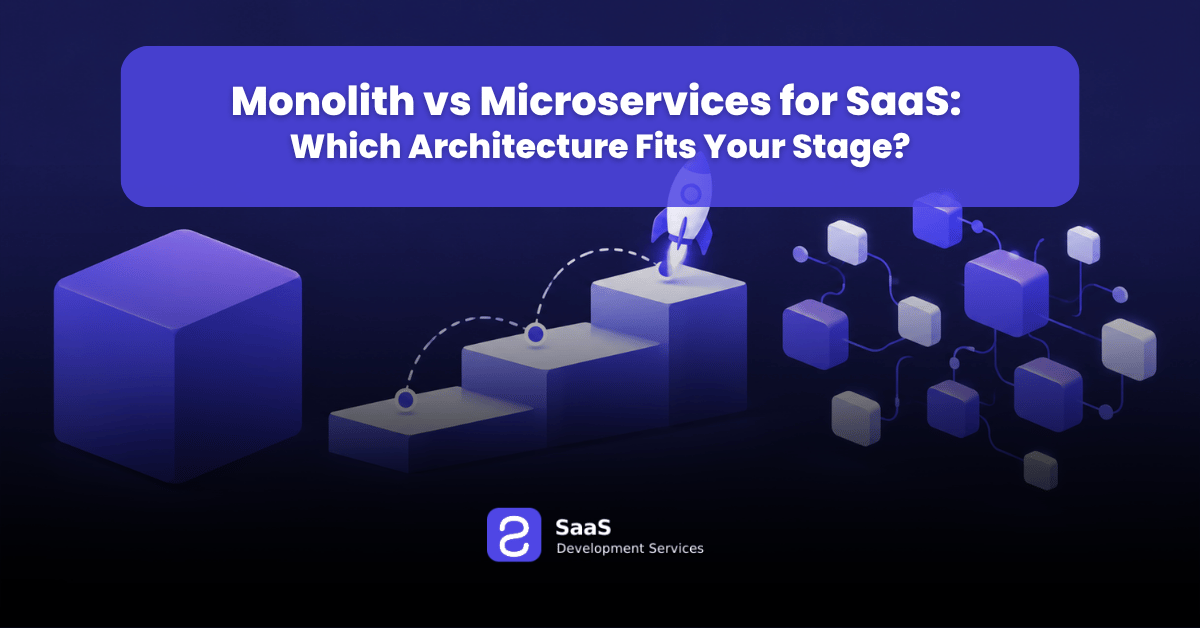
Monolith vs microservices for SaaS is a stage decision, not a matter of taste. Most early stage products should start with one monolith, move to a modular monolith as the team grows, and split into microservices only when a specific problem forces it. Three things decide the right fit: team size, how often parts of the product change, and which parts must scale on their own. This guide gives you a stage by stage answer, real company examples, and clear signs for when to switch. Treat it with the same care you would give any serious saas development services project.

What Is the Difference Between a Monolith and Microservices?
A monolith is one application with one codebase that you deploy as a single unit. Microservices split the product into small services, each with its own code and deployment, that talk to each other over a network. The real difference is how many moving parts you build, run, and connect.
| Factor | Monolith | Microservices |
| Deployment | One unit | Many independent units |
| Communication | Function calls inside the app | Network calls (APIs, queues) |
| Debugging | One log and one stack trace | Requests traced across services |
| Team needs | Small team can manage it | DevOps skills and several teams |
| Starting cost | Low | Higher (hosting, monitoring, tooling) |
Why Do Most SaaS Startups Start with a Monolith?
Startups begin with a monolith because speed matters more than scale before product market fit. One codebase means faster builds, simpler testing, lower hosting cost, and no early guessing of service boundaries.
- One deployment and one place to debug when something breaks.
- Database transactions keep billing and subscription data consistent.
- A small team ships features without coordinating across services.
Martin Fowler explained the pattern in his 2015 article on monolith first design. He observed that almost every successful microservices story began as a monolith that grew too big, while systems built as microservices from day one often ended in serious trouble. If you plan custom saas development, this lesson can save you a lot of rework.
What Does Microservices Really Cost a Young SaaS Team?
Microservices add a cost that Fowler calls the microservice premium. You pay for network failures, data consistency across services, extra monitoring, and more deployment work.
Segment is a clear example. Its data pipeline grew to more than 140 services, and three full time engineers spent most of their time keeping the system alive instead of building features. After the team merged everything into one service in 2018, improvements to its shared libraries rose from 32 in the microservices era to 46 in the following year.
Watch out for the distributed monolith too. If your services share one database or must be deployed together, you carry the full cost of microservices and get none of the benefits. Budget for this premium when you plan saas product development services or hire a team.
When Do Microservices Make Sense for SaaS?
Microservices make sense when several teams need to release on their own, when one part of the product needs very different scaling, or when rules force strict separation of data. If none of these is true, a monolith is cheaper and faster.
- Many teams: Developers block each other in one codebase and releases wait in a queue.
- Uneven load: One feature, such as report exports or file processing, uses far more resources than the rest.
- Data rules: Payment or health data needs a hard boundary between environments.
- Team skill: You already run monitoring, tracing, and automated deployment well.
Products built through enterprise saas development services reach these needs sooner, because large buyers often ask for strict data separation and high uptime.
What SaaS Specific Factors Change the Decision?
Tenant isolation, billing, and security all push the choice one way or the other, so check them before you commit.
- Multi tenancy: A shared database with a tenant ID is simple in a monolith. Buyers who demand isolated data may force an extraction later.
- Billing and subscriptions: These need reliable transactions, so keep them close to your core data.
- Security: Every new service adds endpoints, secrets, and access rules that you must protect.
- Compliance: Rules such as SOC 2 or HIPAA can justify a separate service for regulated data.
Teams that rely on saas application development services should ask how each point is handled in the design.
What Is a Modular Monolith and Why Does It Work for SaaS?
A modular monolith is one deployable application split into clear modules with strict rules about how they talk. You get monolith speed today and clean boundaries for later.
Shopify shows it works at a large scale. Its engineering team has reported that the core app holds more than 2.8 million lines of Ruby code split into 37 components, and it built a tool called Packwerk to enforce the boundaries between them. Here is how to build the same structure in a smaller product:
- Group code by business area, such as billing, users, projects, and notifications.
- Let each module own its tables, and block other modules from reading them directly.
- Connect modules through clear interfaces only.
- Add automated checks that fail the build when someone breaks a boundary.
Ask your saas app development company to set these rules in week one, because they are hard to add later.
Which Architecture Fits Your SaaS Stage?
Match the architecture to your stage. Teams before product market fit need a simple monolith. Growing teams need a modular monolith. Large teams with proven, separate domains can extract microservices one at a time.
| Stage | Typical team | Best fit | Why |
| Idea and MVP | 1 to 5 engineers | Monolith | Fast and cheap while you test demand |
| Early traction | 5 to 15 engineers | Modular monolith | Clean boundaries without network cost |
| Scaling | 15 to 50 engineers | Modular monolith plus a few extracted services | Split only the hot or isolated parts |
| Large organization | 50+ engineers | Microservices owned by teams | Independent releases start to pay off |
These team sizes are a rule of thumb, not a law. Your domain and skills matter more than headcount.
Can a Monolith Handle Scale?
Yes. A monolith scales by running several copies behind a load balancer, and sometimes it even cuts cost.
The Prime Video team that monitors video quality moved from a distributed serverless design to a single process application and reduced infrastructure cost by over 90 percent. That was one tool, not all of Prime Video, so the lesson is to match design to workload. Teams planning saas platform modernization services should test costs like this before they split anything.
What Signs Show It Is Time to Move from a Monolith to Microservices?
Move when a repeating problem blocks you, not when the codebase simply feels big. Five signals matter most.
- Teams block each other and releases wait for a shared deploy slot.
- One part of the product needs very different scaling from the rest.
- Deploys are slow and risky, and a small change can break unrelated features.
- Rules or large customers demand separate data or separate environments.
- Your module boundaries are already clean and enforced by tests.
Extract one service at a time, starting with the part that changes most or scales differently, and keep the monolith running. If your product is already a tangled monolith, saas modernization services can map a safe order of extraction before any code moves.
Frequently Asked Questions
Should a SaaS startup start with a monolith or microservices?
Start with a monolith and build it in a modular way. It is faster, cheaper, and easier to change while you learn what customers want.
When should a SaaS company switch to microservices?
Switch when a repeating problem blocks you, such as teams waiting on each other or one feature needing separate scaling. Size alone is not a reason.
Is a modular monolith better than microservices?
It is not better in every case, but it is cheaper and simpler until you need independent releases. It also prepares your code for a later split.
Are microservices more scalable than a monolith?
Microservices let you scale one part on its own, which can save resources. A monolith can still scale by running more copies, and it avoids the network overhead between services.
Can I move from a monolith to microservices later?
Yes, if your modules have clear boundaries and separate data ownership. A trusted saas software development company can review your codebase and show which module to extract first.
Summary
The right choice depends on your stage, so begin with a monolith, add clear modules as your team grows, and split into microservices only when a real problem repeats. Segment, Prime Video, and Shopify show that simple, well structured designs often beat early complexity. For help choosing, work with a saas development company that reviews your team, data, and growth plan first.
Need a second opinion on your architecture? Contact us here.