Designing an effective SaaS onboarding flow means getting a new user to their first real result as quickly and smoothly as possible. This guide covers the four building blocks behind that, sign-up, activation, in-app guidance, and follow-up messaging, with sourced benchmark data, plus two things often missing: choosing the right onboarding pattern and measuring whether the flow works.
Key Takeaways
- Median B2B SaaS activation is 35 to 40 percent; best-in-class products reach 60 to 70 percent within 30 days (OpenView SaaS Benchmarks)
- A complete onboarding flow covers four parts: a fast sign-up, a clear activation milestone, in-app guidance, and behavior-based follow-up
- Design toward the activation milestone, the one action that proves value, not full feature coverage
- Pick the onboarding pattern, checklist, wizard, or guided walkthrough, based on whether setup tasks are independent or sequential
- Track activation rate, time to first value, completion rate, and week one retention to see if the flow works
What Is a SaaS Onboarding Flow?
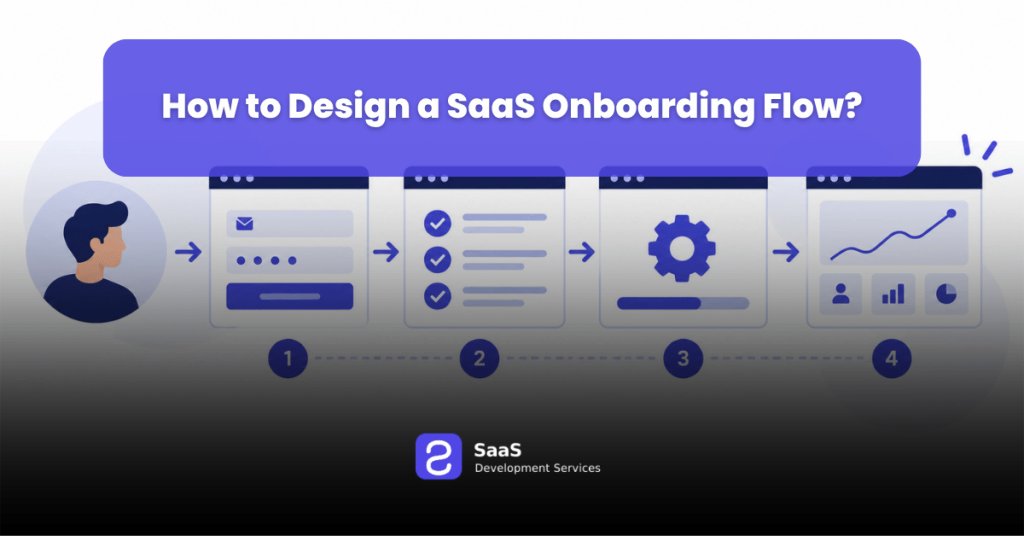
A SaaS onboarding flow is the structured sequence of screens, setup steps, and prompts that take a new signup from an empty account to a working one. Its job is to answer one question fast: does this product solve my problem, not to give a full feature tour.
A working onboarding flow usually includes:
- Signup and account creation
- A short setup step tied to the user’s use case
- One guided first task that produces a real result
- Empty states that tell users what to do next, not just that nothing exists yet
- In-app prompts and email nudges tied to what the user has and has not done
Why Does Onboarding Flow Design Matter for SaaS Growth?
Onboarding flow design matters because most new signups never reach the point where the product proves its value. OpenView’s SaaS Benchmarks research shows best-in-class B2B products reach 60 to 70 percent activation within 30 days, while the median sits between 35 and 40 percent, a gap that is almost entirely a design problem.
A weak onboarding flow shows up across the business, not just in usage numbers:
- Higher support ticket volume from confused new users
- Lower trial to paid conversion
- Early churn that shows up before the first invoice
- Slower expansion revenue, since users who never activate rarely upgrade
Planning onboarding as part of the original build is far cheaper than fixing it after launch, which is why it gets scoped early in most custom saas development projects rather than added on as an afterthought.
How Do You Streamline the Sign-Up Process?
The sign-up step is the first place users drop off, so it should ask for the least amount of effort possible before letting someone in.
- Minimize fields: ask only for what is essential, such as email and password, to reduce friction
- Enable social login: let users sign up with Google, Apple, or single sign-on to skip a new password
- Personalize by intent: ask two to four short, goal-oriented questions instead of collecting demographics nobody needs yet
How Do You Define the Activation Milestone?
The activation milestone is the one action that proves your product works. Getting this definition wrong is the most common reason onboarding flows guide users toward the wrong outcome.
- Work backward: identify the single action that proves value, the way Slack targets a user’s first sent message, and design every step around it
- Eliminate fluff: cut feature explanations, welcome modals, and setup steps that delay this first win
- Avoid blank states: pre-populate accounts with templates or sample data so users see a working interface, not an empty screen
If you are still scoping a new product, defining this milestone belongs in the same conversation as how to build a SaaS MVP in 90 days, not a decision left until after launch.
How Do You Guide Users with In-App Patterns?
Once a user is inside the product, in-app guidance carries them from the activation milestone toward regular use.
- Use interactive checklists: break setup into small, actionable tasks with visible progress
- Apply progressive disclosure: show basic features first and reveal advanced tools only when needed
- Use contextual tooltips: trigger a hint when a user touches a feature, not a wall of pop-ups at login
Which Onboarding Pattern Fits Your Product?
In-app guidance usually takes one of three shapes, and the right choice depends on how the setup tasks relate to each other. Picking the wrong pattern is what turns a simple checklist into a wall of pop-ups.
| Pattern | Best for |
|---|---|
| Checklist | Setup tasks users can complete in any order |
| Wizard | Linear setup where each step depends on the last |
| Guided walkthrough | Teaching one feature at a time inside real work |
Products going through a platform rebuild often keep the wizard pattern from the older version and only redesign the steps that cause drop off. This is a common approach in saas modernization services work, where the goal is fixing what is broken rather than rebuilding onboarding from the ground up.
How Do You Automate Email and Multi-Channel Follow-Ups?
Onboarding does not end when the user closes the tab. Follow-up messaging brings them back before momentum is lost.
- Send the welcome email immediately: a fast, well-timed email keeps the signup fresh in mind
- Trigger messages by behavior, not calendar: base follow-ups on what a user has or has not done, such as a nudge after 48 hours of no activity
- Write copy around outcomes: frame every message around what the user achieves, not the steps they still need to click
What Common Mistakes Break a SaaS Onboarding Flow?
Most onboarding flows fail for a small set of repeated reasons:
- Teaching every feature instead of the one that proves value
- Asking for full profile completion before the user has done anything real
- Using the same flow for every user type instead of separating by role or use case
- Never measuring where users drop off, so problems repeat release after release
- Treating onboarding as a one time build instead of a part of the product that gets updated
How Do You Measure If a SaaS Onboarding Flow Is Working?
A small set of metrics shows whether an onboarding flow is doing its job.
| Metric | What it tells you |
|---|---|
| Activation rate | Share of signups who complete the action that proves value |
| Time to first value | How long it takes from signup to that first result |
| Onboarding completion rate | Share of users who finish the guided steps |
| Week one retention | Share of users still active seven days after signup |
A saas development company that reviews these numbers after every release, not just after launch, is far more likely to keep activation climbing over time instead of watching it decay as the product grows.
Frequently Asked Questions
How long should a SaaS onboarding flow take?
Aim for under fifteen minutes to first value. Simpler products can do it in under a minute; more complex tasks naturally take longer.
What is a good activation rate for a SaaS product?
OpenView’s SaaS Benchmarks research puts median B2B activation at 35 to 40 percent, with best-in-class products reaching 60 to 70 percent within 30 days. Falling below the median points to a structural onboarding problem, not just a product one.
Should onboarding be different for free trial and paid users?
Yes. Trial users need to reach value fast enough to justify paying, so keep their flow short and focused. Paid users can be guided toward deeper features and team setup once activation is confirmed.
Do B2B SaaS products need a different onboarding flow than B2C?
Yes. B2B onboarding often needs role based setup, team invites, and admin controls early on, while B2C onboarding focuses on a single user reaching value fast, with fewer configuration steps.
How often should an onboarding flow be updated?
Review onboarding whenever a core feature changes, and check drop off data at least once a quarter. Treating it as finished after the first build is a common reason activation rates fall over time.
What is the difference between onboarding and a product tour?
A product tour shows users where things are located. An onboarding flow gets a user to a real result, and a tour can be one part of it, but not the whole thing.
Conclusion
A SaaS onboarding flow works when it moves a new user to a real result in the fewest steps, not when it explains every feature. Streamlined sign-up, a clear activation milestone, the right in-app pattern, and behavior-based follow-up together separate best-in-class activation from the median. Products that treat onboarding as part of the ongoing release cycle, not a one time launch task, keep activation climbing as they grow.