How to choose a SaaS tech stack for your product comes down to four checks. Does your team know the tools? Do they fit what the product must do? Do they meet what your customers require? Can you afford to run them? Pick proven tools that pass all four, test them on one small slice of the product, and delay every choice you do not need yet.
Most founders copy a famous company’s stack or pick whatever is new. Both lead to slow builds and costly rewrites. This guide gives you a clear order of decisions instead.
What Is a SaaS Tech Stack?
A SaaS tech stack is the group of programming languages, frameworks, databases, and cloud tools used to build, run, and support your software. It decides how fast you launch, how well the product handles growth, how safe customer data stays, and how much you pay each month to keep it online.
Stack problems rarely show on day one. They show when the first hundred customers arrive and every change takes longer than it should. This is why good saas development services start with the stack question before anyone writes code.
What Are the Core Layers of a SaaS Tech Stack?
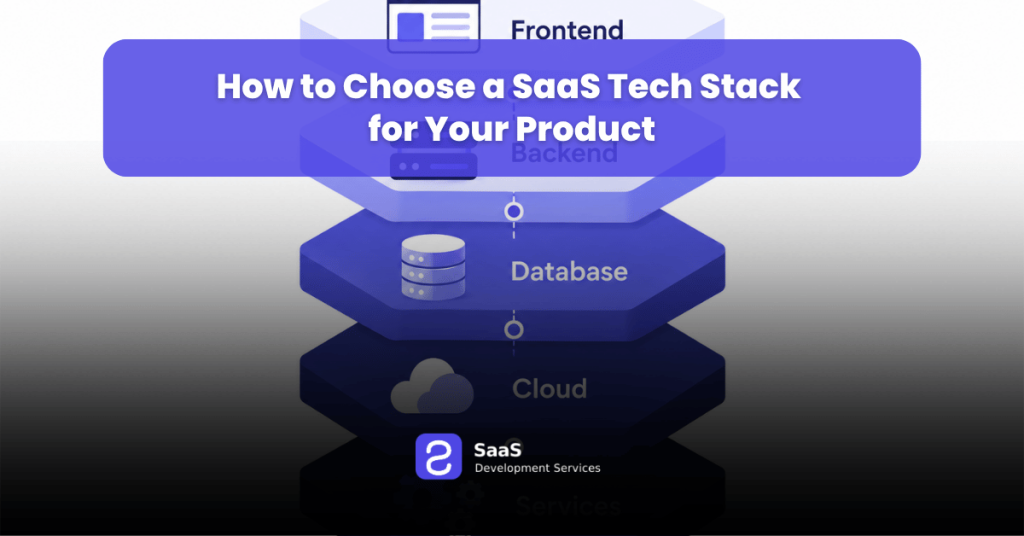
Every SaaS product has five core layers: frontend, backend, database, cloud infrastructure, and supporting services. Each layer has a few safe, well supported options, and you need only one choice per layer to begin.
- Frontend: What users see and click. React or Next.js with TypeScript is the most common choice.
- Backend: Where business logic runs. Node.js and Python, with Django or FastAPI, lead here.
- Database: Where customer data lives. PostgreSQL is the default for most products.
- Cloud infrastructure: Where the app runs. AWS, Google Cloud, Azure, and Vercel are the usual picks.
- Supporting services: Login, payments, email, and error tracking. Stripe, Clerk or Auth0, and Sentry are common.
PostgreSQL earns its default status. In the 2025 Stack Overflow Developer Survey, it was the most used database, with 55.6% of developers using it. It handles structured data, supports JSON fields, and has strong tools for tenant isolation, covered below.
Two layers get skipped in most guides: billing and background jobs. Subscription billing, payment retries, and scheduled tasks shape your backend design early, so plan for them on day one.
How Do You Choose a SaaS Tech Stack Step by Step?
Choose your stack in six steps: define requirements, check team skills, list customer demands, plan tenant isolation, match your growth stage, and run a small test. This order keeps trends from driving the decision.
Step 1: Which Product Requirements Should You Define First?
Write down what the product must do before you compare any tool. List these five items:
- Core workflows and the data each one creates
- The number of users you expect in the first 12 months
- Integrations such as payments, CRM, or accounting tools
- Real time needs, like live dashboards or chat
- Any AI features, since they change your data and hosting needs
A clear list also helps when you compare saas product development services, because every partner can quote against the same scope.
Step 2: What Does Your Team Already Know?
Build with the languages your team already understands. A familiar stack launches faster than a perfect stack nobody has used. Also check the hiring pool. JavaScript, TypeScript, and Python have large talent markets. If your team lacks a key skill, a saas app development company can fill the gap while you hire.
Step 3: What Do Your Customers Require?
Your buyers set rules your stack must follow. Healthcare buyers expect HIPAA controls. European customers fall under GDPR, which allows fines up to 20 million euros or 4% of yearly global turnover, whichever is higher. Many business buyers ask for a SOC 2 report before they sign.
Security is also a cost issue. IBM’s 2026 Cost of a Data Breach Report puts the global average breach at $4.99 million and the United States average at $11.5 million. Pick tools with audit logs, encryption, and role based access built in. If you sell to large companies, single sign on comes up quickly, and enterprise saas development services plan for them from the start.
Step 4: How Will You Separate Customer Data?
Tenant isolation is how one customer’s data stays hidden from another. Choose your approach now, because changing it later touches every table. You have three options:
- Shared tables: Every row carries a tenant ID. This costs the least and is fastest to build.
- Separate schemas: Each customer gets its own schema. You get more isolation and more upkeep.
- Separate databases: Each customer gets its own database. This is the strongest isolation and the highest cost.
Most early products start with shared tables. PostgreSQL row level security adds a safety net, because the database blocks rows that belong to other tenants even if the application code has a bug.
Step 5: Which Stack Fits Your Growth Stage?
- MVP or early product: Next.js, Node.js or Python, PostgreSQL, and one cloud host. Speed and low cost matter most.
- Growth stage: Add Redis for caching, a job queue, and monitoring. Split out services only where a real bottleneck exists.
- Enterprise: Add single sign on, audit logs, regional hosting, and compliance reports. This is where custom saas development usually pays off, because standard tools rarely cover every buyer rule.
- AI native: Add a vector store such as pgvector and strict access rules on data sent to models.
Step 6: Can You Prove the Stack With a Small Test?
Build one thin slice before you commit. A good test covers sign up, creating a record, charging a test card, and deploying to a live server. Give it one to two weeks. If the team struggles, you learn that at a small cost.
Should You Start With a Monolith or Microservices?
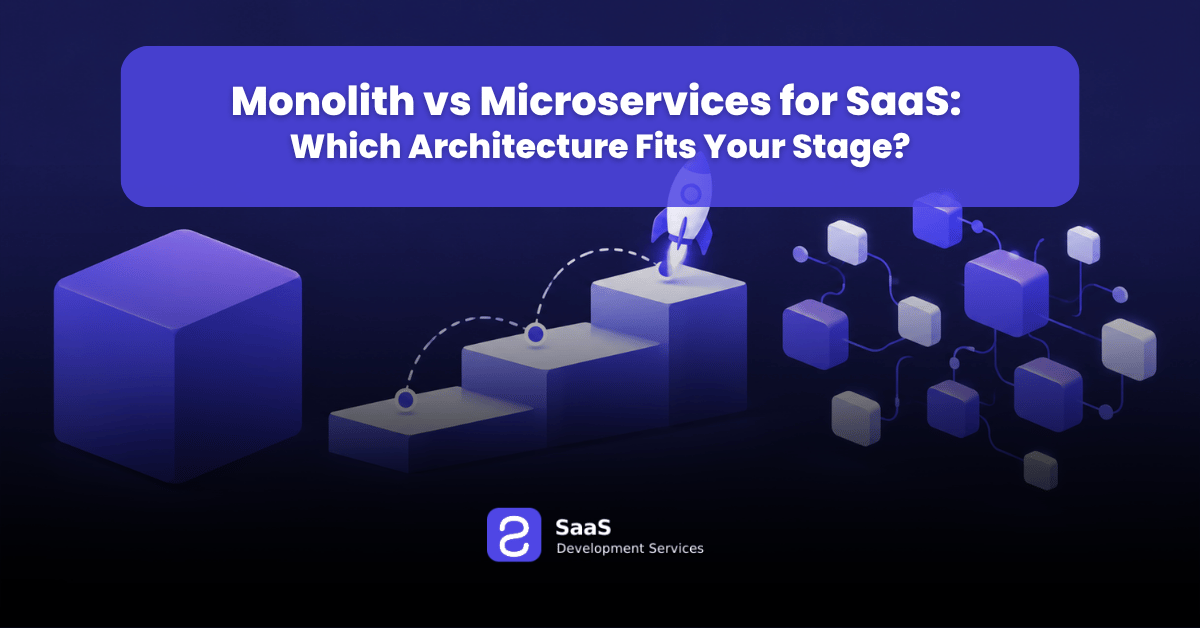
Start with a monolith. A monolith is one codebase and one deployment, which is faster to build, test, and fix for a small team. Microservices split the product into many small services, which adds network calls and more things that can break.
Amazon’s Prime Video team showed the cost of splitting too early. In 2023, it reported that moving one video monitoring service from microservices to a single process cut infrastructure cost by over 90%. That was one service, not all of Prime Video, but the lesson holds: split only when a real bottleneck proves you must. A modular monolith leaves that door open, and teams that need saas application development services at larger scale can split it later with far less pain.
What Mistakes Should You Avoid When Choosing a SaaS Tech Stack?
The most common mistakes add cost that shows up months later.
- Designing for millions of users on day one: Pick a simple stack that ships fast, then improve it.
- Chasing the newest tool: A niche framework with a small community turns every missing feature into custom work.
- Locking in with no exit: Use open standards, such as PostgreSQL and standard APIs, so you can change hosts.
- Adding security late: Login, encryption, and access control cost more to add after launch.
If you already run a live product on an aging stack, saas modernization services can move it forward in steps while customers keep using it.
When Should You Ask for Expert Help?
Ask for help when your stack choice touches compliance, enterprise buyers, or a tight launch. A second opinion costs far less than a rebuild. A saas development company can review your requirements, test your shortlist, and flag risks early. If you want a review of your plan, Contact us here.
FAQs About Choosing a SaaS Tech Stack
What is the best tech stack for SaaS in 2026?
There is no single best stack. A safe default is Next.js with TypeScript, Node.js or Python, PostgreSQL, and AWS or Vercel. Change it only if compliance, data, or AI needs point elsewhere.
Should I choose a tech stack before or after defining features?
After. Features and workflows decide what the stack must support.
Is Node.js or Python better for a SaaS backend?
Both work well. Node.js lets one team use JavaScript across frontend and backend. Python is strong for data and AI work. Pick what your team knows.
How much does the tech stack affect SaaS development cost?
A lot. The stack shapes developer rates, hosting bills, and build time. Ask a saas software development company to price your shortlist.
Can I change my tech stack later?
Yes, but the cost depends on the layer. Swapping a UI library is cheap. Changing your database or tenant model is expensive. For a staged move, saas platform modernization services can replace one layer at a time.
When should I move from a monolith to microservices?
Move when one part of the product needs to scale alone, or when teams block each other in one codebase. Before that, microservices add cost without clear gain.
Summary
Choosing a SaaS tech stack works best when you define requirements first, pick proven tools your team already knows, and plan for customer rules such as security and tenant isolation. Most competing guides list popular tools and stop there, while this one adds an ordered process, stage based picks, a small proof test, and a clear answer on monolith versus microservices. Follow those steps and you launch faster, spend less on rework, and keep room to grow.