Multi-tenant SaaS architecture is a model in which one application instance and one database serve many customer organizations whose data stays logically separated, while single-tenant SaaS architecture gives each customer a fully dedicated application instance and database. Every SaaS company eventually has to choose between the two, or a blend of both.
What Is Multi-Tenant SaaS Architecture?
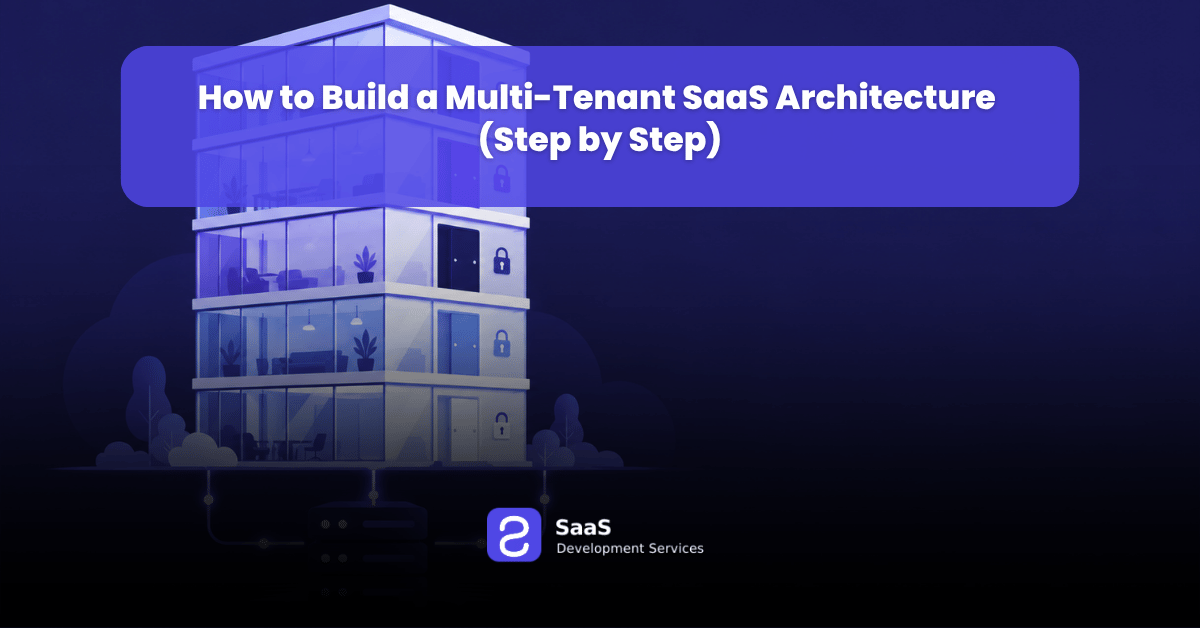
Multi-tenant SaaS architecture is a software delivery model in which a single application instance and a single underlying database serve multiple customer organizations, called tenants, whose records are logically isolated from one another through tenant identifiers, dedicated schemas, or row-level security policies.
Multi-tenant architecture’s resource model is shared infrastructure. Multi-tenant architecture’s isolation method is logical separation rather than physical separation. Multi-tenant architecture’s cost structure is shared and amortized across every tenant on the platform. Multi-tenant architecture’s typical adopters are broad-market B2B SaaS products such as CRM, project management, and billing platforms.
A tenant ID column on every table, Row-Level Security (RLS) policies, or schema-level segregation are the common techniques that keep one tenant’s records invisible to another. When engineered correctly, every tenant runs the same codebase and receives the same updates the moment they ship, a pattern our Custom SaaS Development team designs around from day one so isolation is never bolted on after launch.
What Is Single-Tenant SaaS Architecture?
Single-tenant SaaS architecture is a deployment model in which each customer receives a dedicated application instance, a dedicated database, and sometimes dedicated hardware, so no compute, storage, or network resource is shared between tenants at any layer of the stack.
Single-tenant architecture’s resource model is dedicated infrastructure per customer. Single-tenant architecture’s isolation method is physical separation. Single-tenant architecture’s cost structure is higher and dedicated per customer. Single-tenant architecture’s typical adopters are healthcare, finance, government, and enterprise clients bound by strict compliance mandates.
Onboarding a new customer under this model means provisioning a new server, database, and application instance, sometimes on a dedicated subdomain. Teams that later need to restructure a single-tenant codebase for scale usually turn this into a SaaS Modernization engagement rather than a rebuild from scratch.
What Are the Key Differences Between Multi-Tenant and Single-Tenant SaaS?
The core difference between the two models is whether resources are shared or isolated. Multi-tenant SaaS pools infrastructure across customers, while single-tenant SaaS dedicates a full stack to each one, and that single distinction drives every downstream tradeoff in cost, security, and speed.
| Aspect | Multi-Tenant SaaS | Single-Tenant SaaS |
|---|---|---|
| Infrastructure cost | Low, shared across all tenants | High, dedicated per tenant |
| Data isolation | Logical, enforced in software and database policy | Physical, enforced by separation |
| Customization | Limited to configuration and feature flags | Deep, including custom code paths |
| Scalability | Scales horizontally as one system | Scales one dedicated environment at a time |
| Onboarding speed | Fast, a new tenant record only | Slower, requires new provisioning |
| Updates and patches | Deployed once for all tenants | Deployed per tenant instance |
| Noisy neighbor risk | Present without careful design | Not present |
| Compliance fit | Workable with strong controls | Simplifies strict regulatory mandates |
| Typical buyer | SMB and mid-market SaaS users | Enterprise, regulated, or on-premise clients |
What Are the Benefits of Multi-Tenant SaaS?
Multi-tenant SaaS delivers lower cost per customer, faster onboarding, and centralized maintenance because every tenant runs on one shared, continuously updated system rather than a separate deployment.
- Cost efficiency: infrastructure and maintenance spend is spread across every tenant on the platform, which lowers the price per customer.
- Faster onboarding: a new customer is a new database record, not a new server, so activation can happen in minutes.
- Centralized maintenance: one codebase and one database mean bug fixes and features reach every tenant in a single deployment.
- Simplified scaling: adding compute to the shared pool benefits every tenant at once instead of scaling instances one by one.
What Are the Benefits of Single-Tenant SaaS?
Single-tenant SaaS delivers stronger data isolation, deeper customization, and predictable performance because each customer’s environment is physically separated from every other customer’s workload.
- Strong isolation: a tenant’s data lives in its own database, which removes the risk of a shared-database misconfiguration exposing records.
- Deep customization: clients can request custom code, integrations, or configuration changes that apply only to their instance.
- No noisy neighbors: dedicated compute means one tenant’s traffic spike can never slow down another tenant’s environment.
- Compliance alignment: dedicated infrastructure simplifies data residency and audit requirements common in HIPAA, GDPR, and FedRAMP environments.
What Are the Trade-Offs and Risks of Each Model?
Multi-tenant SaaS trades some customization and isolation for cost efficiency, while single-tenant SaaS trades cost and deployment simplicity for maximum control, and neither trade-off is free.
- Multi-tenant risk: a flaw in access control logic can expose one tenant’s data to another if isolation is not engineered correctly.
- Multi-tenant risk: a single tenant’s heavy usage can degrade performance for others, known as the noisy neighbor problem, unless rate limiting is in place.
- Single-tenant risk: version drift occurs when some tenants delay updates, leaving the provider to support multiple software versions at once.
- Single-tenant risk: provisioning a new environment for every customer adds operational overhead that grows linearly with the customer count.
How Does Tenant Isolation Work Inside a Multi-Tenant System?
Tenant isolation inside a multi-tenant system is achieved through a small set of proven techniques, ranging from a simple tenant ID filter to a fully dedicated database per customer, and the right technique depends on how sensitive the data is.
| Isolation Method | How It Works | Best Fit |
|---|---|---|
| Tenant ID column | Every table carries a tenant_id filtered on each query | Early-stage products with simple data models |
| Row-Level Security (RLS) | The database enforces tenant filtering, not just app code | Products where a query bug cannot be risked |
| Schema-per-tenant | Each tenant gets a separate schema in one database | Mid-size SaaS needing stronger isolation than RLS alone |
| Database-per-tenant | Each tenant gets a dedicated database instance | Enterprise or regulated tenants inside a hybrid model |
These techniques are not mutually exclusive. Many SaaS products start with a tenant ID column, add Row-Level Security as the customer base grows, and move specific high-value or regulated accounts to a dedicated schema or database later. This is the kind of decision our Platform Architecture service is built to plan for before the first line of code is written.
When Should a SaaS Company Choose Single-Tenant Architecture?
A SaaS company should choose single-tenant architecture when its buyers are large enterprises, regulated industries, or customers that require dedicated environments, custom code, or on-premise deployment as a condition of the contract.
- Your target customers operate under HIPAA, GDPR, FedRAMP, or similar regulations that mandate data residency or physical isolation.
- Enterprise buyers are requesting custom features, integrations, or SLAs that only make sense inside a dedicated environment.
- Your pricing model can absorb the higher infrastructure cost, typically because contract values are high enough to justify a dedicated stack.
Vendors that sell a rebrandable, dedicated product to partners or resellers often land here by default, which is why single-tenant patterns come up constantly in our White Label SaaS builds.
When Should a SaaS Company Choose Multi-Tenant Architecture?
A SaaS company should choose multi-tenant architecture when it is targeting a broad market of SMB or mid-market customers, needs to ship updates quickly to everyone at once, and wants to keep infrastructure cost low while it proves the product.
- You are validating product-market fit and need to onboard customers quickly without provisioning new infrastructure for each one.
- Your roadmap depends on shipping features to every customer simultaneously rather than managing version drift across instances.
- Cost efficiency and lean operations matter more at your current stage than deep, per-customer customization.
This is the default architecture we recommend for most first builds, which is why multi-tenant patterns are baked into our SaaS MVP Development process from the initial data model onward.
Can a SaaS Product Combine Both Models?
A SaaS product can combine both models through a mixed-tenancy architecture, where most customers share a multi-tenant core while specific enterprise or regulated accounts run on a dedicated schema, database, or instance within the same platform.
- A freemium or standard tier runs on the shared multi-tenant database for cost efficiency and fast onboarding.
- A premium or enterprise tier is isolated into its own schema or database to satisfy compliance and customization demands.
- Modern serverless database platforms make database-per-tenant far cheaper than it was in traditional single-tenant deployments, narrowing the gap between the two models.
Products with AI features add another layer to this decision, since model access, prompt data, and usage limits often need per-tenant boundaries of their own. Our AI-Powered SaaS work regularly builds this kind of tenant-aware isolation directly into the AI layer, not just the database.
How Does SaaS Development Services Help You Choose and Build the Right Architecture?
SaaS Development Services helps founders and product teams choose between multi-tenant, single-tenant, and hybrid architecture by mapping the decision to their target buyer, compliance requirements, and growth stage before any code is written.
Our Platform Architecture service defines the tenancy model, data isolation strategy, and scaling plan up front. From there, Custom SaaS Development and SaaS MVP Development turn that architecture into a working product, while SaaS Modernization supports teams that need to move from single-tenant to multi-tenant, or add isolation to an existing shared database, as they scale.
You can read more about our approach on the About Us page, or Contact Us to talk through which architecture fits your product.
Frequently Asked Questions
Is multi-tenant or single-tenant SaaS more secure?
Single-tenant SaaS offers stronger isolation by default because tenants never share a database, while multi-tenant SaaS can reach an equivalent security level through Row-Level Security, tenant ID enforcement, and strict access control, but it requires disciplined engineering rather than physical separation to get there.
Can a SaaS product switch from single-tenant to multi-tenant later?
Yes, but it is a significant re-architecture rather than a configuration change, since every part of the data model and application logic needs to become tenant-aware, which is why most teams plan for multi-tenancy from the start even if they launch with fewer customers.
What is mixed-tenancy or hybrid SaaS architecture?
Mixed-tenancy architecture is a model where most customers share a multi-tenant core while select enterprise or regulated customers are isolated into a dedicated schema, database, or instance within the same overall platform.
Do enterprise clients always require single-tenant deployment?
No, many enterprise clients accept a well-isolated multi-tenant environment as long as it meets their compliance and security requirements, though some regulated industries and government contracts still mandate physical isolation by policy.
Which architecture do most SaaS startups choose?
Most SaaS startups choose multi-tenant architecture by default because it minimizes infrastructure cost and lets the team ship updates to every customer at once, reserving single-tenant or hybrid options for enterprise deals that specifically require them.
Conclusion
Multi-tenant and single-tenant SaaS architecture are not competing philosophies so much as two points on a spectrum of shared versus dedicated infrastructure. The right choice depends on who your customers are, how sensitive their data is, and how quickly you need to ship. Most SaaS companies start multi-tenant and add isolation where it is actually needed, rather than building for every edge case on day one.
If you are weighing this decision for your own product, our team can help you map it against your roadmap and buyer profile. Contact Us to start the conversation.